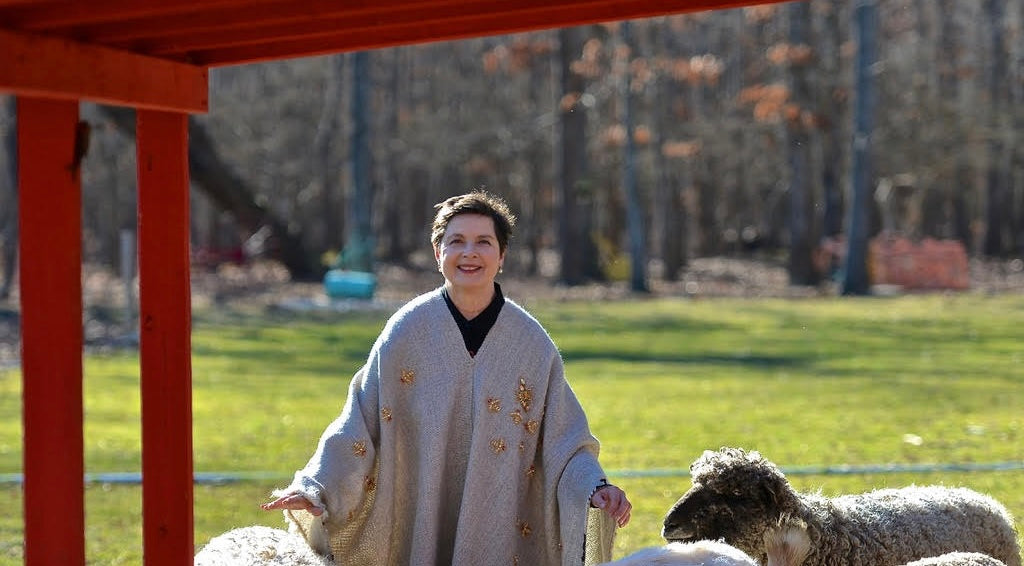
Article: Camilla Esseteg – Queen of the Garden.

Camilla Esseteg – Queen of the Garden.
Camilla is perhaps best known alongside her husband, renowned chef Paul Svensson, and for their shared passion for growing and cooking food. They have appeared together in several productions and guest appearances, and most recently published their book "Lätt att odla. Gott att laga". What many people may not know is that Camilla is actually the formally trained chef in the duo and the queen of the garden that provides so much of what ends up in their kitchen.

When and how did your interest in food and growing begin?
I’m a trained chef, which I don’t think many people know. My husband Paul studied engineering and ended up in a kitchen during his military service, when he worked as a chef aboard HMS Karlskrona.
Since it’s difficult to have two parents both working evenings and weekends, I gradually moved more towards administration and finance, which have always interested me as well.
What do you enjoy most growing, harvesting or cooking what you’ve grown?
I probably enjoy the growing part the most and harvesting, of course. Harvesting feels like a reward for having done something right and seeing your hard work pay off, even though there are always things you can’t control.
And then I enjoy it even more when Paul does the cooking!

When do you start planning for the next growing season?
We sow our first seeds in December or January. If you want to grow chillies and peppers, you really need to start early because they take such a long time.
After that, we don’t really get going again until around the end of March or beginning of April. In between, we take stock of the seeds we have left and decide what we want or need to add.
I’m not sure I dare say this, but I actually enjoy having a little break from growing during the winter. The season is very intense and takes a lot of time even though I absolutely love it.

You and Paul recently published a new book "Lätt att odla. Gott att laga". What was the idea behind it, and how did you divide the work?
The book project has been so much fun. It has been wonderful doing it together and working with everyone involved from the publisher to the photographer, illustrator and editor.
The idea was to inspire people to start growing and to show how easy it can be to get started. You don’t need a big garden, a pot on a balcony works perfectly well.
You can begin with some of the easier vegetables that more or less take care of themselves and give a generous harvest. That makes growing even more rewarding. Is there anything better than picking your own lettuce leaves, a zucchini or a few tomatoes?
You can start small and expand over time. That’s exactly what we have done.
Being able to show what you can cook with your harvest has been an added bonus. Take beetroot, for example, it’s not just the root. The leaves are delicious simply fried in a little oil and salt.
I have mainly focused on the growing and everything around it, while Paul has focused on the recipes and cooking. We have written many of the texts together, while others we wrote individually.

What is it like working with your husband?
We have always worked together on and off, so it feels very natural to us. We actually met in a restaurant kitchen in England 29 years ago.
We’re good at dividing the work according to what we enjoy and what we’re good at. It often happens naturally without us having to say much, and we support each other when needed.
Although in the kitchen, I probably wouldn’t dare have too many opinions...
What is the most rebellious thing you have done, or still do, in your life?
My calling is probably recycling. We sort almost everything, and despite having three children, we rarely need to empty our general waste bin. When we do, it’s usually because there was some packaging that was difficult to clean and started to smell.
I’m originally from Linköping, and when I first moved to Stockholm, recycling had just started becoming established back home. In Stockholm, they hadn’t even really started. I began collecting Tetra Pak cartons in a basket in the kitchen, and when the basket was full, I stored them in my storage room.
Even when we’re on holiday in the archipelago or the mountains, I take our rubbish home if there’s nowhere to recycle it. It physically hurts me to throw recyclable things into general waste.
I have to admit that I get quite frustrated when I visit people, whether friends or family and discover that they throw everything into the same bin. Paul tells me I have to be a little careful so I don’t scare people!
In 2026, I think we should have come much further. Recycling should simply be second nature to everyone.

Three things you always have in your fridge?
I find it difficult to live without dairy products, so I would say eggs, milk and plain yoghurt or quark.
At Wool Rebel, we try to see Swedish wool as a valuable resource rather than a waste product. Do you recognise that way of thinking in how you grow and cook?
We try to plan and eat in a way that minimises waste. Of course, there is always some food waste, but we try to take care of it through composting and/or bokashi (a Japanese method of fermenting food waste).
That way, it eventually comes back to us as something that improves the soil. Anything we can’t take care of ourselves is sorted as food waste.
You have an amazing kitchen garden. How did it come about?
Our garden has developed over many years. When we moved in, we brought a rhubarb plant that a friend had given us, originally from her parents’ garden.
From there, we started experimenting with raised beds, mainly growing different lettuces, tomatoes, sugar snap peas and zucchini.
Over the years, we have expanded with more growing beds, pots, open-ground cultivation and a greenhouse.
Our focus has always been on growing things we enjoy eating, but we have gradually added things we’ve been curious to try. Kale is one of my favourites to grow. Kohlrabi is another, it’s a very underrated vegetable that many people don’t know very well. For us, it has been easy to grow and has produced a great harvest.
Is there anything special you’re planning to cook from this year’s harvest?
That’s a difficult one! We’re now entering the time of year when everything is ripe or beginning to ripen. We simply try to include something from our own harvest in every meal.

What will you save from this year’s harvest?
I always save seeds from our tomatoes, peas and beans. I also save a few Jerusalem artichoke tubers, which will become new plants next year.
We freeze berries and make juice from apples and pears. We usually manage to eat most of everything else, so there isn’t much left to preserve for winter.
We’re also planning to do some fermenting this year, something we haven’t been very good at so far.
Do you have a hidden talent?
I would say I’m a doer, with a knack for finding practical and creative solutions whether at home, in the garden or at work.