Isabella Rossellini- Sheep farmer with glamour.
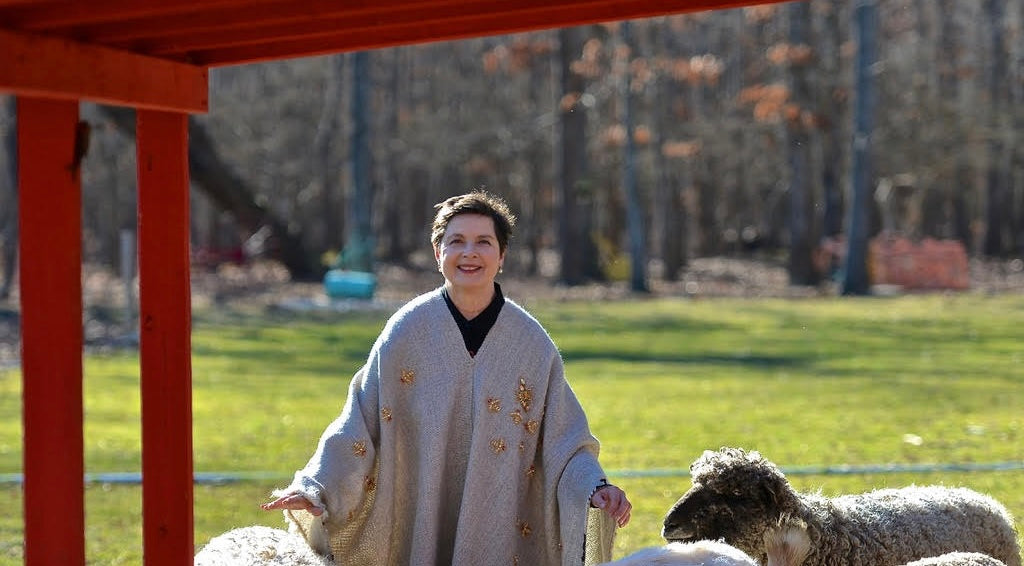
It was our shared interest in making use of wool that would otherwise be discarded that brought us together. I met Isabella Rossellini in her childhood city of Rome but today she lives at her sheep farm, Mama Farm, on Long Island outside New York City.
Isabella is a warm and down-to-earth person despite her extraordinary career as an actress and model, and her upbringing with the renowned parents Ingrid Bergman and Roberto Rossellini. She has always loved animals and holds a degree in animal behaviour so it is no coincidence that she now keeps her own small flock of sheep.

Helena Holmquist, Mary Jeanne Packer, Isabella Rossellini
Isabella, you are a role model to many with such a wide range of talents such as actress, model, designer, mother, grandmother and sheep farmer. You also have a strong public voice. What is most important for you to convey through the wool from your sheep?
When I returned to university to study animal behavior, we focused on elephants and lions, not the animals I see every day like chickens, sheep, and goats. When I began studying them more closely I discovered that much of the wool is simply thrown away. Over the past 50 years wool production has moved overseas to countries like China and New Zealand.
Merino wool, being soft and comfortable, has come to dominate the fashion industry almost like a monoculture. At the same time there are small-scale farmers in New York State working with more unusual breeds.
I began collecting sheep from endangered breeds to preserve biodiversity. Instead of having many dogs or a swimming pool I have a small flock of sheep. Through them I’ve been able to invite people to the farm to learn about sheep and be inspired by the possibilities of wool.

What led you to move from New York City to a farm in the countryside?
When my children were young, like many New Yorkers, we had a country house where we spent weekends. When my daughter started college, I often went there with my son, who cried every Sunday because he didn’t want to go back to the city. So I decided we would move there. As an actress, I could commute, but once we moved, I didn’t want to go back either.
A 28-acre plot became available, and when another buyer withdrew, I was offered it. I couldn’t let go of the idea of preserving it and turned it into a farm.
I started the farm with great optimism without fully understanding the scope. I didn’t realize how time consuming and challenging it would be with bureaucracy, permits, construction and the daily work of running a farm. Fortunately I met Patty Gentry who since then takes care of all vegetables and runs her own business Early girl farm ( https://earlygirlfarm.com/ ) and I focus on the animals. Besides sheep and wool we also have circa 200 chickens, ducks and turkey and sell their eggs to the community. We also have bee hives and sell honey .

You chose to work with the Swedish garden designer Lars Krantz on Mama Farm. How did that come about?
Lars Krantz is, as you know in Sweden, an extraordinary talent. His previous work, (for example Rosendals trädgård and Wij trädgårdar in Ockelbo) made me dream of his landscapes.
He had also designed the garden at my previous home and when I told him about the land for sale he came immediately. He encouraged me to buy and preserve the plot.
At the time, the land was abandoned; it was just forest and meadows. Lars created the farm’s layout and I think every day about how thoughtful his design is. There is space for cultivation, surrounded by green areas where the animals can roam and a planted corridor that offers both protection and privacy. His vision was to connect our land with the surrounding National park landscape.

Do you have a favorite sheep?
I don’t have a favorite—I love them all. Some are shy, others more social.
Toto, a Finn sheep, is very affectionate while his brother Pepe (Peppino) is more reserved. But since he stays close to Toto I can sometimes pet him as well.
Another sheep, Georgia O’Keeffe, is a Lincoln Longwool which is an unusual breed with long fleece that must be shorn twice a year. They are among my favorites because they are so gentle.
And then there’s Greta Garbo, she is just like Greta Garbo. Sometimes she is nice, sometimes not, sometimes she wants to be touched and sometimes not.
You offer educational programs about wool for the public and for students. Why is that important to you?
At first I opened the farm to friends and their friends. They were so enthusiastic and kept coming back. The local community has truly embraced the farm.
I began organizing more and more events to inspire people to use wool in different ways and to teach how wool becomes yarn. We can’t leave the gates open due to regulations, this is America after all, but through organized events it works well.
Lars Krantz once told me that mothers with children would become my first supporters and he was right. That’s why it’s called Mama Farm but also because I run it together with my daughter Elettra Rossellini Wiedemann.
Most of the animals at the farm are female. We have hens, ewes and 91% of the bees are female, so there’s a strong feminine energy on the farm.
What is it like running Mama Farm together with your daughter?
Working together, especially as a family, can be both rewarding and challenging. The line between work and private life easily blurs.
I am responsible for the animals, our wool collection and the educational programs, while Elettra organizes seminars, courses, events and runs Mama Farm’s Bed & Breakfast.
My responsibility is also financial. Financially it’s tough for small farms. We try to break even, so my acting work helps in difficult times.
How do you take care of your wool?
Our shearer, Tabbitha Houbold, shears the sheep on the farm. The wool is then washed, carded and spun locally by Mary Jeanne Packer at Battenkill Valley Fibers https://www.battenkillvalleyfibers.com/. If the yarn is woven, that is also done locally by Lilly Marsh https://lillymarshstudios.com/. Artist Mimi Prober then makes ponchos and blankets from the wool. Each piece is unique, often incorporating elements like raw fleece or lining made from dresses that I don’t wear anymore. https://www.mimiprober.com/

What is the most rebellious thing you’ve done?
I don’t know if I’ve done anything particularly rebellious. I follow my curiosity and it sometimes leads me to places that may seem unconventional.
People often ask why I don’t just focus on acting, but I enjoy both acting and working with sheep and why can’t I do both? For me it’s not about rebellion, it’s about curiosity and independence.
What’s next for your work with wool?
We recently opened a Lab in Bellport Village, near Mama Farm, where we explore what can be done with wool from heritage breeds. Mimi Prober also works there and we collaborate on creative development.
We work exclusively with local wool from New York State and nearby regions like Pennsylvania and Vermont. Like Wool Rebel we discovered that much of this wool is discarded. We are trying to find new ways to use it and encourage others to do the same.
Just as people choose local produce at farmers’ markets, I want them to choose local wool. The wool available here is coarser than merino, so it requires a different design approach.
Instead of designing first and then sourcing materials, we start with the material and let it guide the design, much like with the Wool Rebel’s Awassi jacket.
When do you wear your Awassi jacket?
I started wearing the Awassi jacket this winter. We had the coldest winter ever in New York, with temperatures dropping to –20°C and it was fantastic.
It’s incredibly warm and insulating. Now I just wish there were matching trousers because I was cold on my legs! I would love to have more Wool Rebel pieces.


Written by Helena Holmquist